Regulation
Everything You Need to Know about New Chain Liability Law for 2026



Regulation

Starting Jan 1, 2026, there are new Flemish Chain Liability (Ketenaansprakelijkheid) rules.
We get it. You’re looking for answers, but all you’re finding is dense legal jargon. It’s overwhelming.
That’s why we’ve put together this guide to help you understand the new Chain Liability rules in a nutshell, without the headache!
Below, we break down:
Chain liability refers to the fact you (as a principal client or contractor), will be held liable for your sub/contractor's illegal third-country nationals they employ.
In the past, clients or contractors could avoid chain liability for illegal employment via a written statement between the client/contractor and a direct sub/contractor, which stated that no illegal workers are employed, nor will they be employed.
But after high-profile judicial investigations in the industrial sector and findings that 1 in 3 companies were involved in social fraud, the result is clear: the regulatory environment is tightening.
The 2026 change flips the burden of proof:
See Section 5 below for more details!
Crucial Detail: This applies to any company (domestic or foreign) involved in activities in the Flemish Region. It doesn't matter if your subcontractor is Belgian, Polish, or Brazilian, so long as the work happens in Flanders.

You might think, "chain liability doesn't affect me that much, so I don't have to care."
Let's debunk some top misconceptions.
Major industry federations like Bouwunie have welcomed the tightening legislation.
"We must combat all forms of social dumping and the associated unfair competition for our companies. We are pleased that Flanders is also cooperating with this decision." - late Bouwunie CEO Jean-Pierre Waeytens
Associations and organisations across varied fields (e.g. Prebes, the association for prevention advisors; Acerta and Securex, HR service providers etc.) have also begun disseminating the new legislation changes in their communications.
"It's no longer sufficient for the compliance officer or prevention advisor to request a statement; the document review process must be structurally embedded in the organization." - Prebes
So we know why legislation is tightening, how the field at wide is reacting, and that different roles in an organization should care.
Now let's jump straight into the details!
Yes. Liability extends to every link in the supply chain.
However, the conditions that apply in terms of your liability differ depending on your relationship with your sub/contractor.
(You signed the contract directly with this company)
If the company you hire directly (your direct sub/contractor) employs undocumented third-country nationals, whether as employees or self-employed workers, you, as the client or main contractor, can be held liable.
For contractors performing specific risky activities, stricter rules apply:
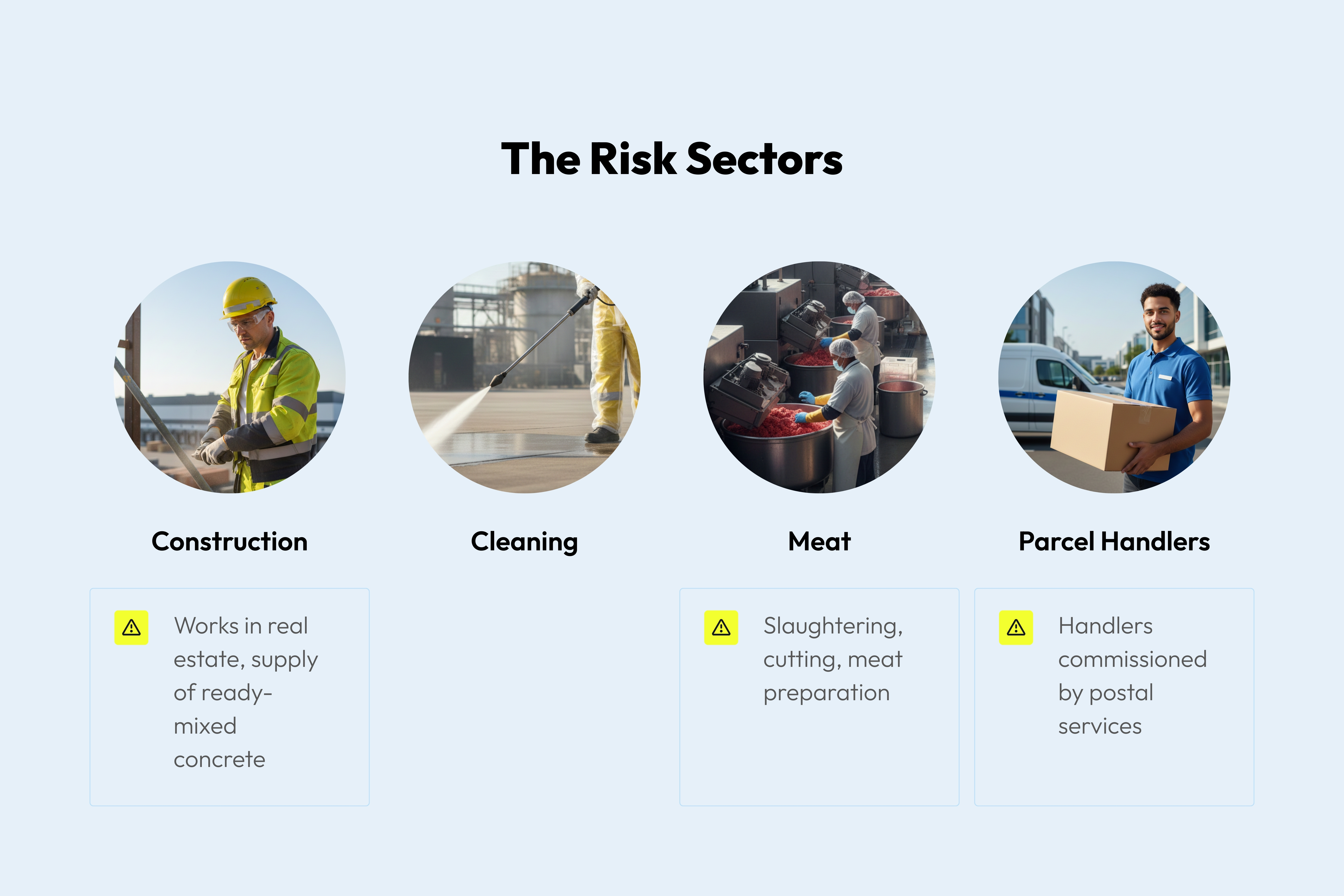
To avoid liability in contractors performing these activities starting January 1, 2026, you must fulfill two mandatory requirements:
%20copy.jpg)
Note: If your direct contractor is NOT in a risk sector, the active duty of diligence doesn't apply, but you still need that written declaration.
(Your contractor hired a subcontractor)
If an indirect sub/contractor employs irregular third-country nationals, the principal, main contractor, or intermediate contractor can only be held liable if they had prior knowledge of the illegal employment.
The burden of proof lies with the inspection services to demonstrate that this prior knowledge existed.
However, it is still advised to request and verify specific documents from sub/contractors (such as IDs and residence permits) to effectively demonstrate that all employment is legal.
If you operate in (or hire companies performing activities in) the risk sectors, pay attention.
"But I'm a chemical company, not a cleaning company!"
It doesn't matter. If your chemical plant hires an external cleaning crew, you become the Principal in a Risk Sector relationship. You are liable for checking those cleaners.
The same goes for construction, which covers any work on immovable property. This means installation, repair, and maintenance on your site all count.
The operational burden differs depending on your role in the chain.
To avoid liability, follow the 7-Step Duty of Diligence process defined by the Flemish Government.
These regulations are mandatory for all companies, whether Belgian or foreign, that are involved, either directly or indirectly, in activities within Flanders.
Does your direct (sub)contractor operate in the 4 risk sectors, and are they above the financial thresholds?
Third-country nationals are individuals who are not citizens of the European Union (EU), the European Economic Area (EEA), or Switzerland.
If such individuals perform work in Flanders, whether as employees or self-employed persons, it is mandatory to verify their residence status to determine if they are staying in the country legally.
You must obtain specific documents to prove that your direct (sub)contractor is not employing irregular third-country nationals (whether as employees or self-employed).
The required documents depend on the origin of the posting or employment:

Note: Blatant forgeries or invalid documents are considered as absent documents.
You must store these documents for 5 years after the collaboration ends.
They must be available for inspection services upon request.
If you discover that documents are missing, clearly forged, or invalid, you must immediately contact your (sub)contractor and request the correct documentation.
If your (sub)contractor fails to respond, you are required to report the issue to the Vlaamse Sociale Inspectie (Flemish Social Inspectorate). By filing this report, you officially discharge your duty of diligence and can no longer be held liable for the infringement.
Read on more below to find out how to file a report.

The 2026 Decree represents a shift: the future of contractor management lies in active verification.
It's well worth integrating tools in your organization that can seamlessly keep up with ever tightening legislation, and thereby alleviate your headaches!
Here's how to prepare:
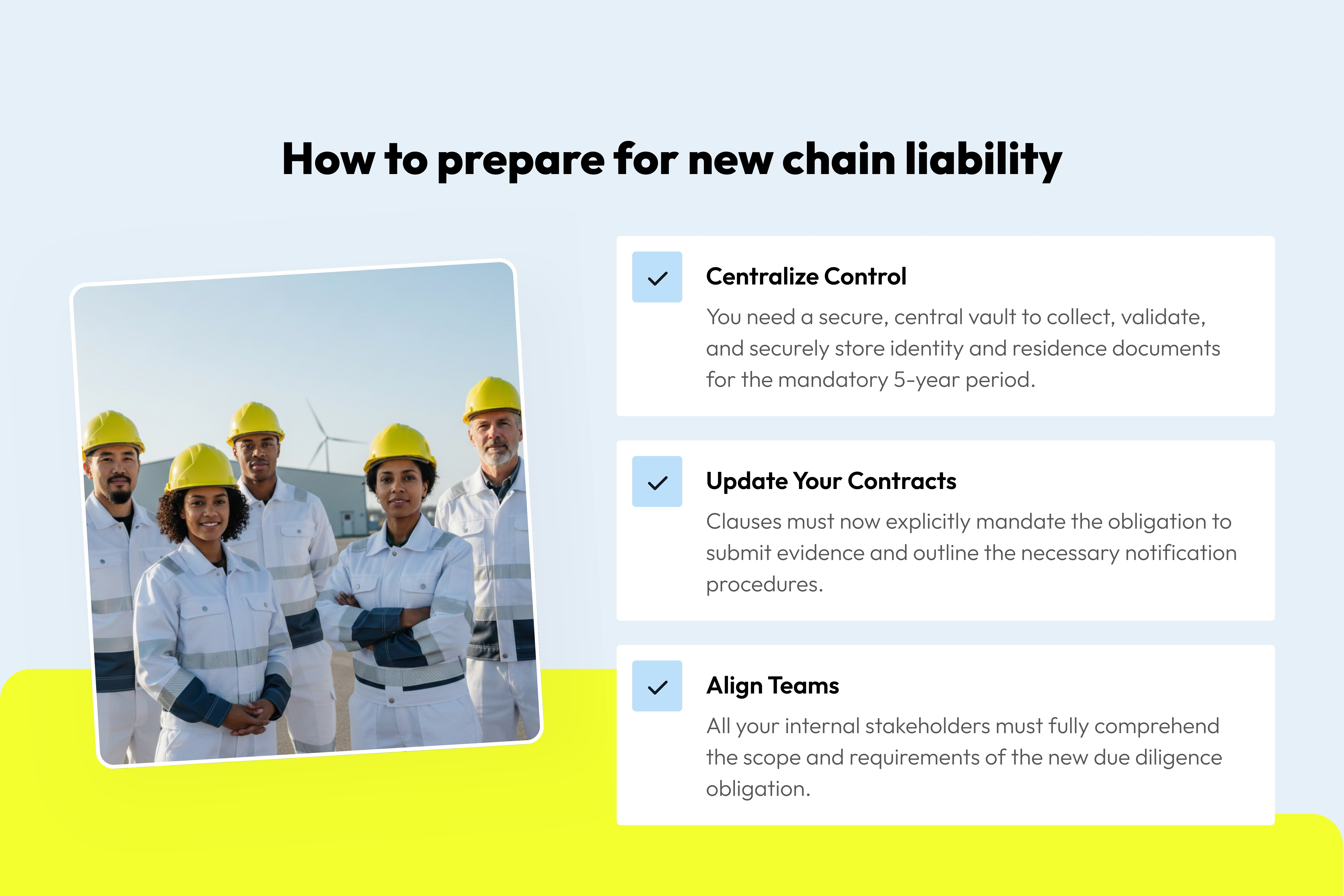
While the law takes full effect on Jan 1, 2026, there is a 6-month grace period before full enforcement begins on July 1, 2026. Use this time to move from reactive panic to proactive control.
9ID automates the administrative heavy lifting, ensuring you effortlessly stay compliant with the new rules and relieves you of administrative burden.
Discover how 9ID automates compliance for the new Flemish Decree.
This guide is intended for informational purposes and summarizes the new Flemish Decree on Chain Liability. It does not constitute legal advice.
Information:
Legislation: